
175,000 Tourists, Not 5.5 Million: What the World Cup Teaches Any Brand That Measures Results
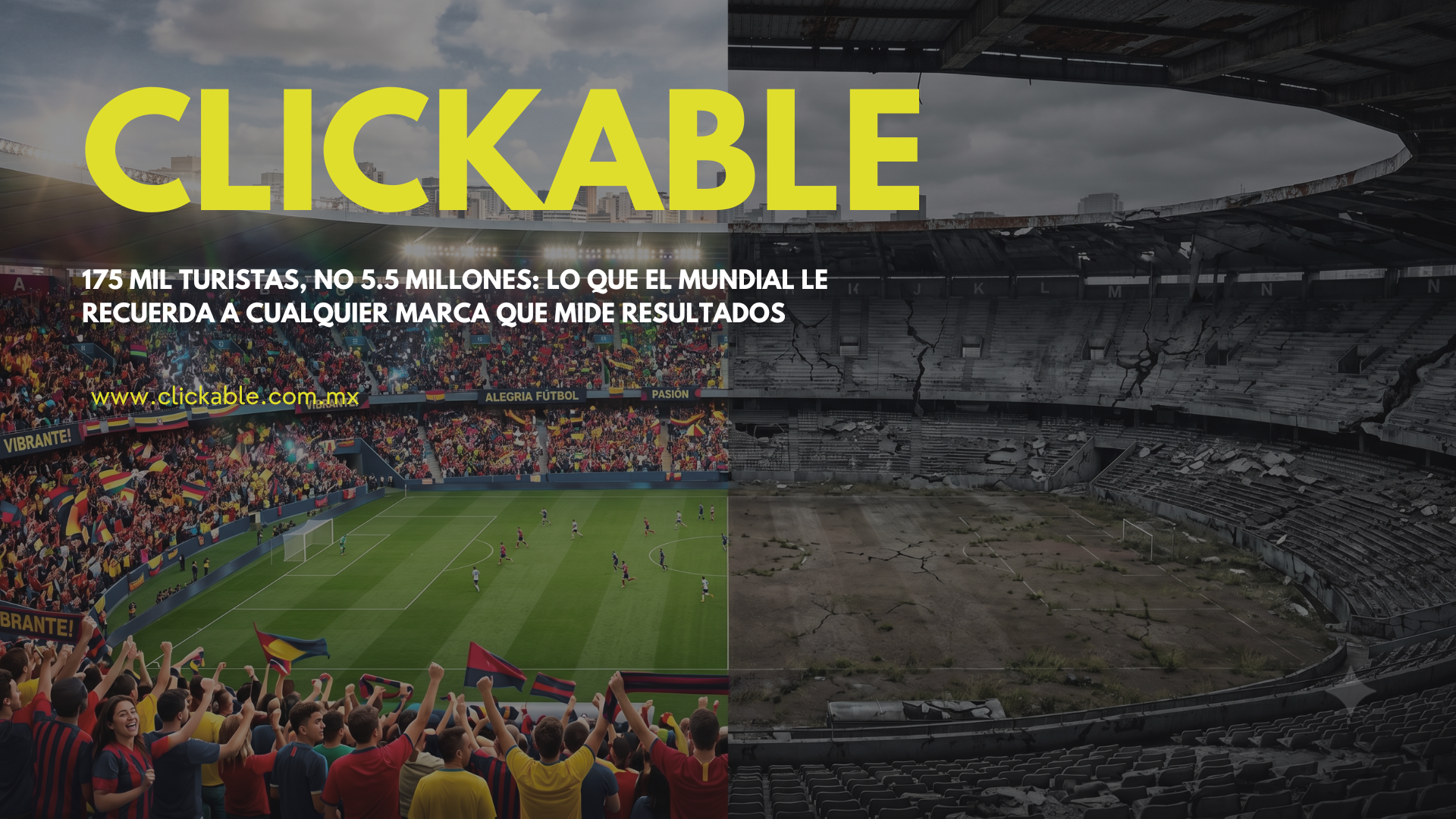
For more than two years, the official story stayed the same: the 2026 World Cup would bring up to 5.5 million additional tourists to Mexico. That number was repeated in press conferences, government plans and tourism growth forecasts.
Preliminary data from the National Business Tourism Council (CNET) and the Center for Advanced Research in Sustainable Tourism (STARC Anáhuac Cancún), reported by Xataka México, tell a different story. Around 850,000 tourists arrived in total during the tournament, of which only 175,000 can be directly attributed to the World Cup. CNET's president was blunt in questioning the official figure in remarks to Bloomberg Línea: no one has explained where that projection came from.
The contrast gets more uncomfortable when compared to 2025. That year, with no World Cup, Mexico received 47.78 million international tourists, a 6.1% increase and more than 31.7 billion dollars in revenue, according to INEGI and Ministry of Tourism figures cited by Forbes México. Hotel occupancy during the tournament, far from spiking, actually fell compared to June 2025: Mexico City dropped 2 percentage points, Guadalajara 7, and Monterrey 5.8. Hotels made up for it by raising rates between 39% and 47%, not by filling rooms.
And it wasn't a surprise to everyone. Before the tournament kicked off, specialist Francisco Madrid had already pointed out that available air capacity made it practically impossible to reach 5.5 million additional visitors. The official projection never had support in real seat inventory.
The lesson isn't about tourism, it's about how you measure success
At Clickable we've operated for years under a simple rule: result vs. objective, never just result. A big number with no comparison is a vanity metric. And a vanity metric, when it becomes the basis for investment decisions, gets expensive.
What happened with World Cup tourism is that same error at national scale. An attractive number was projected to sell the "historic opportunity" narrative, repeated unquestioned for two years, and when it came time to measure it against reality, it didn't even beat the performance of a normal year. That's not a tournament that "underperformed" commercially. It's a projection that was never designed to hold up against data.
The same logic applies to any media campaign, brand launch or agency pitch. If a forecast can't be broken down into a verifiable assumption (available air capacity, real inventory, historical conversion rate), it isn't a projection: it's an optimistic expectation disguised as data.
What did work: exposure
It's worth saying this too, because honesty isn't just pointing out what fell short. Both STARC and Francisco Madrid agree that the tournament's biggest legacy may not be the tourist count, but the international exposure Mexico gained as a destination, after years of little federal investment in promotion. That's a real result, measurable in other terms, and probably more lasting than any one-month spike.
The difference between a number that sounds good and a result you can defend in front of a board, a client or an investor is exactly the work we do every day: separating expectation from data, and building strategy on the latter.
Is your brand making media investment decisions based on projections that were never compared against a verifiable target? Let's talk.

Let's talk about your business, not your marketing budget.
Tell us the real challenge behind the project and we'll build the proposal.
Book a conversation